CURRENT Athens was an online platform for the promotion of contemporary art (2017–2026).

Monday: 11:00-15:00,
Tuesday-Friday: 11:00-19:00,
Saturday: 11:00-15-00,
August: CLOSED
Kalfayan Galleries presents the solo exhibition of Antonis Donef, titled "Time's Witness". The opening of the exhibition will take place on Tuesday, June 10, 2025, from 19:00 to 21:00. The text accompanying the exhibition is written by Panos Giannikopoulos (Curator – Art Historian).
In his fifth exhibition at Kalfayan Galleries, Antonis Donef declares himself a “Time's Witness", transforming the gallery space into a "library of time" where anything can happen, and all interpretations are possible. His work is both a renegotiation of knowledge and time. Remaining true to the fundamental elements of his technique—interventions on pages where knowledge is gathered (archival printed materials such as dictionaries, encyclopedias, maps, etc.) and the organic development of the design with ink in the form of automatic writing—Antonis Donef adds more color to his new works in an effort, as he states, "to capture an even larger piece of time with his painting."Labyrinthine iconography, calligraphic design, humor, the conscious and the unconscious, the visible and the invisible, memory, knowledge, and imagination coexist harmoniously in the multi-layered painting surfaces of Antonis Donef, which act as "open books."
*A monumental size diptych of Antonis Donef will be presented in June at Unlimited (cur. Giovanni Carmine, Director of Kunst Halle St. Gallen) as part of the participation of Kalfayan Galleries at Art Basel.
Short Bioraphy:
Antonis Donef was born in 1978. He lives and works in Athens. He studied at the Athens School of Fine Arts and the University of Fine Arts in Madrid. His work has been exhibited in numerous solo and group shows in Greece and abroad, UNLIMITED (cur. Giovanni Carmine), Art Basel 2025; MERIDIANS, Art Basel Miami 2024; “Parallel Viewing. Works from the Collection of the Bank of Greece” (cur. Charis Kanellopoulou), B&M Theocharakis Foundation; “Anaparastasi: Reconstruction, Reenactment, Reconstitution”, International Film Festival of Thessaloniki; AMETRIA (Curated by: Nicoletta De Rosa, Alessandro Pasini, Tomaso Piantini, Polina Kosmadaki, Yorgos Tzirtzilakis), Organised by DESTE | ‘Now and Then’, European Central Bank, Frankfurt |‘Hell As Pavilion’ (curated by Nadia Argyropoulou), Palais de Tokyo, Paris et al. In 2005 he was one of the six graduates of the School of Fine Arts to receive an award in the framework of the “A Great Moment for Culture: The Presentation of New Creators – Eurobank Private Banking”. In 2010 he was honored with the Art House Shanghai Award, Ailing Foundation (ArteFiera Bologna, Kalfayan Galleries), accompanied with an artist residency in Shanghai. In the same year he was a finalist for the "AUDI Award" for his solo exhibition in ‘New Positions’ section as part of the Kalfayan Galleries' participation at Art Cologne. Works by Antonis Donef are in distinguished collections in Greece and abroad.
Antonis Donef | “Time’s Witness”
10 June – 6 September 2025
Text by Panos Giannikopoulos (Curator – Art Historian)
In Time's Witness, Antonis Donef constructs a topography where printed matter, drawing, and form interact through layered temporality. Each page, sourced from encyclopedias, atlases, or other compendiums, carries traces of knowledge systems while welcoming processes of alteration. These elements form strata of accumulated attention. As they gather gesture, pigment, and trace, they generate temporal densities that invite visual and cognitive drift.
Donef approaches the page as a responsive material ecology. Selection emerges from receptivity rather than thematic fixity. A document enters the process through its capacity to host inscription, absorb rhythm, and sustain duration. Ink, and colour traverse the surface, following pathways shaped by pauses, hesitations, and playful reiterations. Each work evolves through gradual accretion, where intervals of stillness and intervention carry equal weight. Pages receive layers without closure, holding presence through the accumulation of care. Meaning arises through the convergence of material, textual, and gestural elements. Printed words intertwine with drawn lines and chromatic zones. Legibility becomes one register among many, contributing to a surface that sustains reading, seeing, and sensing in parallel. Visual density encourages a mode of attention attuned to fine variations in texture, scale, and rhythm. The eye navigates across spatial relationships that privilege proximity and return. Orientation follows paths of resonance rather than directive hierarchy.
The textual operates alongside the visual, generating hybrid conditions of reception. Jerome McGann, in The Textual Condition (1991), articulates how the physical attributes of texts, pagination, typography, layout, compose a bibliographic code inseparable from semantic content. Donef works from within this expanded textual field. His compositions activate the material logic of books as sites of embodied reading. Paper, typeface, and organisational schemes participate in a choreography of activation. They lend weight to gesture and sustain the elasticity of interpretation. Reading becomes a movement of the body across space and surface. Maps open into speculative arrangements or transform into architectures of deviation. Printed schemas invite roaming, tracing, and looping. The act of looking acquires a temporal structure shaped by sequences of return and shift. Each visual encounter unfolds as a passage through micro-events: painterly and printed overlaps, accumulations, and reappearances. The page operates as a spatial syntax, allowing temporal attention to materialise through shifting scales of detail.
Time enters through the structure of the work rather than as a theme or subject. Elizabeth Grosz, in The Nick of Time (2004), describes temporality as a force that thickens, folds, and exerts pressure, perceptible only through matter, space, and interruption. As she writes, “We think of time through the temporality of objects, through the temporality of space and matter, rather than in itself or on its own terms. This is why it cannot be present or present itself, why we cannot look at it directly, why it disappears the more we try to grasp its characteristics. We can think it only in passing moments, through ruptures, nicks, cuts, in instances of dislocation, though it contains no moments or ruptures and has no being or presence, functioning only as continuous becoming”.[1] Donef’s compositions approach these nicks and interruptions as sites of potential. They render visible the irregular intensities and unpredictable emergences that shape our material universe. Duration settles into texture, pigment, and delay. Gestures accumulate through pause and return. Surfaces absorb sequences of labour, holding tension without seeking resolution. Time circulates in the form of residue, a colour that rests, ink that hovers, an abstraction that gradually forms into something else.
Publication fragments engage contemporary rhythms. Their structure interacts with painterly improvisation, diagrammatic extension, and chromatic distortion. Together, these layers sustain a condition of continuous recomposition. Time becomes a topological process shaped by folding and re-entry. Pasts and potentials co-inhabit a visual field that breathes with simultaneity. Worn edges, fading ink or vibrant painterly gestures, and textual irregularities form part of the work’s sensorial structure. These qualities support modes of viewing shaped by tactile memory, archival density, and visual friction. The decay of books evokes death and disintegration, yet the artistic act gestures equally toward preservation, renewal, and resilience. Donef’s multilayered interventions hold entropy in suspension, rendering it visible while delaying its effects, sustaining a fragile equilibrium at the edge of dissolution.
Witnessing arises through a shared condition of inhabitation. Viewer and work synchronize across overlapping tempos, composing a composite present shaped by adjacency, return, and accumulation. Contemporaneity unfolds as entanglement, a field where divergent pulses sustain one another, disrupting linear and unidirectional models of time, and opening space for multiplicities, parallels, and recursive rhythms.
Panos Giannikopoulos
Curator – Art Historian
BIBLIOGRPAPHY
Grosz, Elizabeth. The Nick of Time Politics, Evolution, and the Untimely. Duke University Press, 2004.
Mcgann, Jerome J. The Textual Condition. Princeton, N.J: Princeton University Press, 1991.
[1] Elizabeth Grosz, The Nick of Time Politics, Evolution, and the Untimely (Duke University Press, 2004), 16.
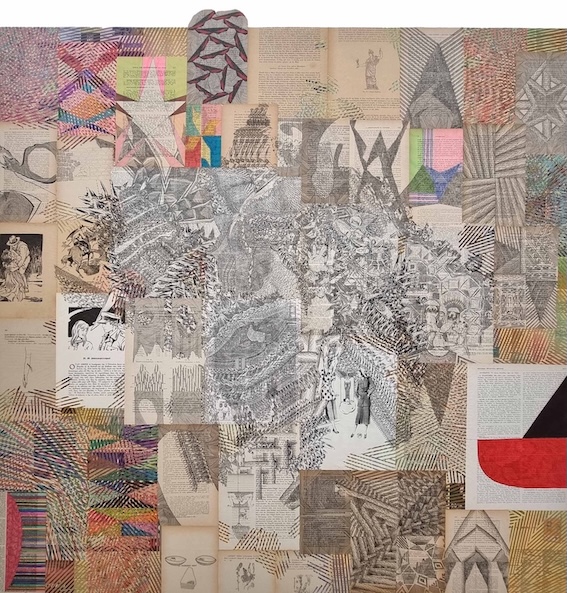
Antonis Donef Unitled, 2025 mixed media and collage on paper mounted on canvas 120 x 120 cm Courtesy the artist and Kalfayan Galleries