CURRENT Athens was an online platform for the promotion of contemporary art (2017–2026).

History Projected #1: History and Myth
History Projected
German-Greek Filmic Dialogues on the Past and Future
Film screenings program in collaboration with Ethnofest
Goethe-Institut Athen
Οmirou 14–16, 10672 Athens
Through a series of screenings that unfold over the course of 2024, Greek and German short and feature films introduce their own dialects and dialectics, assembling different approaches to a common historical past. Micro-narratives and off-beat, soft testimonies in the plural form; studies on mythology and role-plays with masks of national identity; jigsaw puzzles with fragments from the archive; loud and invisible gestures and artifacts break the distance from historical sources and prompt surprising readings on different sides of the border. In the end, history is brought to the present and projected into the future, whereas the language of cinema renders history a sensation, an instinct, and a collective experience.
Episode 1: History and Myth
Wednesday, March 27, 2024
Attempts at appropriating ancient Greek myths fling into the inexhaustible pool of modern history, in two distinct cinematic gestures of exploring contemporary European and national identity. On the one hand, the debut feature by New German Cinema trailblazer Ulrike Ottinger flirts with camp, Dionysian spirit, and Dadaism, to deliver a unique artwork of experimental ethnography. On the other hand, the first feature-length fiction film by Lakis Papastathis – one of the most influential figures in the evolution of Greek documentary – follows the adventurous route of an abduction at the turn of the century; eventually, he unfolds an essentially unique vision of the past's imprint onto the present. In the end, the Greek word for tradition translates as a gift, an act of concession or surrender, a legacy, or a consignment.
18:30
Laokoon und Söhne. Die Verwandlungsgeschichte der Esmeralda del Rio [Laocoon and Sons. The Story of the Transformation of Esmeralda del Rio]
Ulrike Ottinger, 1972/73
50΄ (German with Greek and English subtitles)
19:30
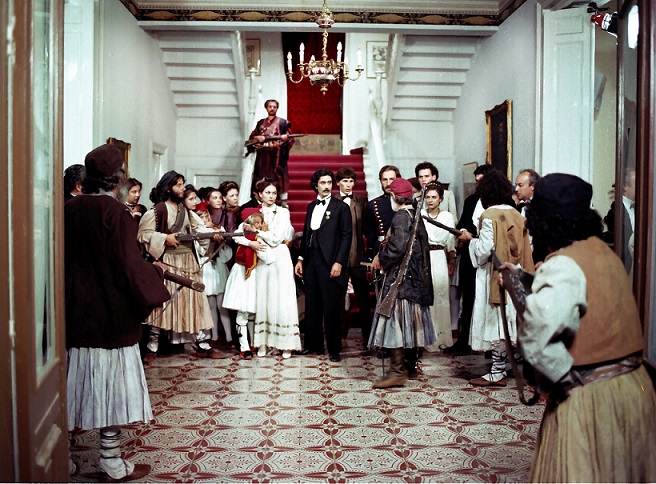
On the Time of Hellenes
Lakis Papasthatis, 1981
100΄ (Greek with English subtitles)
As the widow Olimpia Vincitor, she embarks on a search for her past. Under the name Linda MacNamara, she triumphs as a skater in a duel against the parachute lady Kakalia Katzen. Tristan Tzara appears at the ritual festivals of Laura Molloy's ladies and becomes director of the traveling circus troupe Laokoon and Sons. The death of an artist and the destruction of her studio by seven Erinyes, who emerge from the water in the guise of firemen, are directly related to the appearance of the circus. Finally, Esmeralda del Rio's transformation into a new male role, that of gigolo Jimmy Junod, brings a touch of adventure to the modest but full life of Veronika Dalton, who had taken the name Hubert Dupavillon. But Jimmy Junod's profile is known to the police all over the world.
In 1900, a group of bandits kidnap a young bourgeois and take refuge in the mountains, waiting for ransom for his release. The young man develops a friendship with the leader of the bandits and realizes that the life of these outlaws is much more authentic than his own. A film with references to Vizyinos, Papadiamantis, and popular culture: the old pamphlets, the mythical faces, the Romeic traditions and rituals, and the deep religiosity, always with the harsh mountainous Greek landscape in the background. Papastathis, also outlining the contrast between banditry as a popular uprising and the formation of the modern bourgeois state, finally shows that older forms of popular culture with more modern forms somehow always coexisted.
Directors' Biographies
Ulrike Ottinger has been a unique and provocative voice in German cinema since her debut in the early 70s. Over the past 40 years, she has directed 26 films, including feature-length fictions and experimental documentaries. She received numerous awards, including the Audience Jury Prize in Montréal, the Bundesfilmpreis and the German Film Critics Award. Her films have been shown at many retrospectives, including the Cinémathèque française and Centre Pompidou in Paris, the Reina Sofía in Madrid and the Museum of Modern Art in New York. Ulrike Ottinger has been a photographer throughout her career presenting works at the Biennale di Venezia, the Documenta, and the Berlin Biennale, among others. She has also worked as a theater director and ethnographer and she has published several books.
Lakis Papastathis (1943–2023) was born in Volos and grew up on the island of Lesbos. He shot his first short film (Cases of No) in 1965, while in the period 1970–71 he collaborated as an assistant director with Alexis Damianos on the filming of Evdokia. His third short film (Letters from America) won the First Prize at the Thessaloniki Greek Film Festival in 1972. He shot four feature-length fiction films: On the Time of Hellenes (1981), Theophilos (1987), To monon tis zois tou taxeidion (2001), and Journey to Mytilene (2010). In 1970, together with Takis Hatzopoulos, he founded Cinetic, a production company that became known for its television productions [Historical Archive (1975–1976), (1990–1997), The Revival of Ancient Drama (1998), and, more importantly, for the documentary series Paraskinio (1976–2013) which is the longest-running show on Greek television]. He also published five short story collections.
INFORMATION
Series: goethe.de/ins/gr/en/ver.cfm?event_id=25403728
Episode 1: goethe.de/ins/gr/en/ver.cfm?event_id=25438510
In collaboration with Ethnofest – Athens Ethnographic Film Festival.

©Ulrike Ottinger
©Lakis Papastathis