CURRENT Athens was an online platform for the promotion of contemporary art (2017–2026).

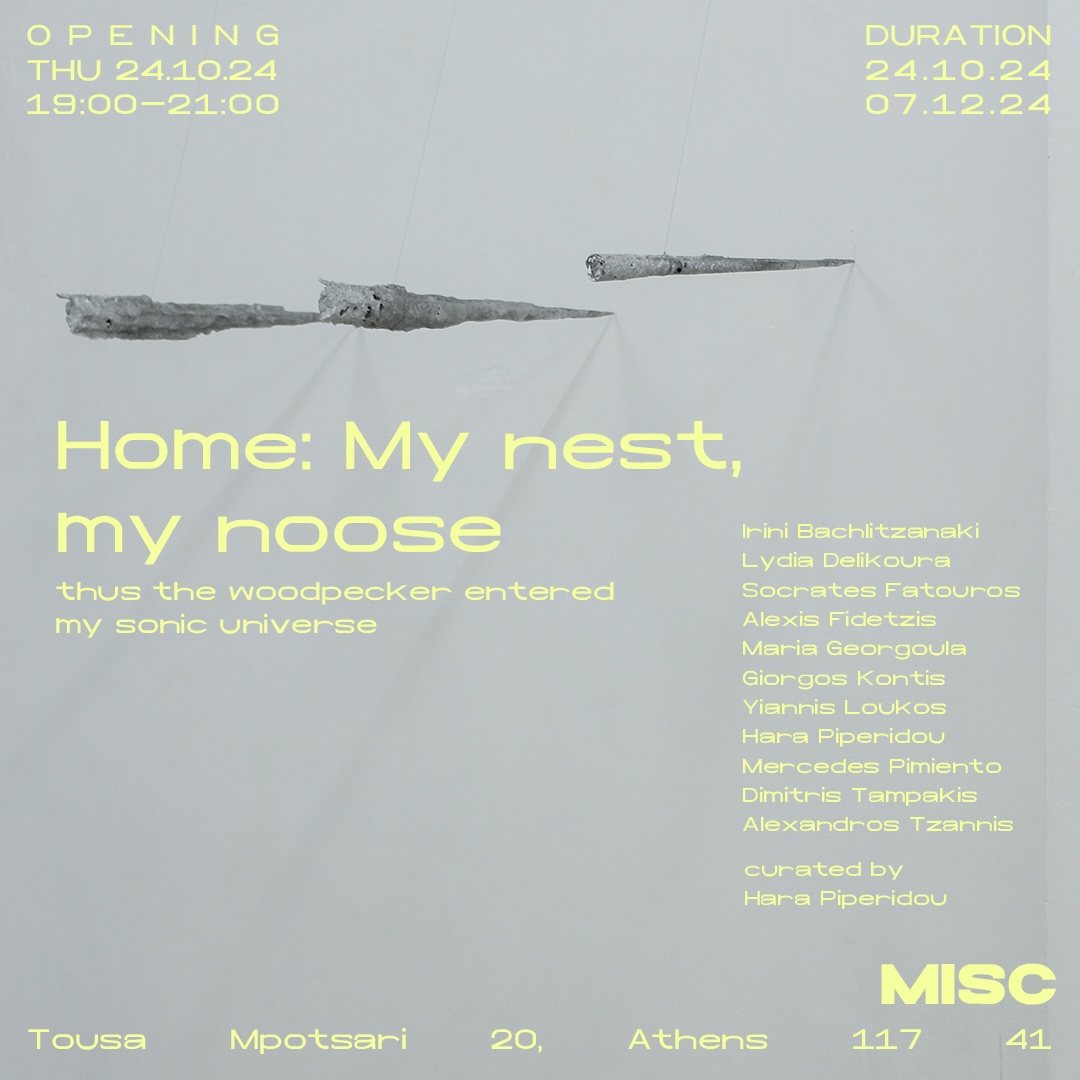
Home: My nest, my noose
Wednesday, Saturday: 12:00-18:00,
Thursday, Friday: 14:00-20:00,
and by appointment
Home: My nest, my noose
Thus the woodpecker entered my sonic universe
I dreamed of a nest whose trees drove away death
I dreamed of a nest where the years no longer slept1
The polymorphous, quick and intense reality distinguished by the rapid and uncontrolled development of new media technology, the spread of nomadism and globalization penetrating all its aspects, causes the physical and mental need for a «home». The general notion of home is being greatly expanded. We encounter the word “home” and the house icon on social media or some Google search engines. However, is digital life, through this appropriation of the context of home, able to recreate, the sense of warm familiarity as much as the lived experience of it?
Does cyberspace have the potential to stimulate our senses as much as reality itself?
Does the perception of corporeality within a virtual reality and within the real world differ?
The essential experience of the physical consistency of the house, as an extension of the self, as a core of concentrated existence, does not merely imply the condition of the physical space as a primary event, but definitely that of poetic contemplation and daydreaming. Can the technological complexity of the digital locus of technoscience evoke that sense of simplicity that is a necessary condition for reverie? Action in cyberspace is rarely and idiosyncratically a physical experience. Of course, the issue is still under consideration. Perhaps, while accepting technological progress, we should maintain a critical attitude. The whole participation of the body as well as the condition of simplicity are fundamental conditions of daydreaming. Only through it can we conceive the house as a trace of an ancient perception of dwelling, as a privileged entity to which our existence turns to, as a primary value that contains, through an invocation of the poetry of space, the element of primitivism, which belongs to all when they accept to daydream.2 «Home» allows us to dream peacefully; it protects us from the «noises of the world» that perturb our mental tranquility3.
Possibly, today we need to reflect on how we inhabit our vital space in harmony with everything around life, how we root ourselves more and more in a “corner of the world”; to contemplate what we call the existence of man through the essence of dwelling ,4 to think of the poetic habi- tation as a fundamental indicative of human empirical existence, as dwell «on this earth».5 Have we perceived the «home» as one of the strongest forces of integration for thoughts, memories, dreams? Have we realized that the same, has a body, has a soul? Have we conceived that through it we can taste the very special silences of solitary reverie, touch the deepest beyond memory, the primordial?6
All of us should draw the plan of our lost countryside,7 daydream of the simple house - nest which is the natural place of the functioning of the dwelling. We return to the first home, as we return to the nest again, because our memories are dreams, because the home of the past has become a great image, that of lost familiarity, authentic warmth. Where everything is internal impulse, intimacy that dominates naturally. The nest is a fruit that swells, pushed to its limits. There one experiences the dynamism of a strange folding, which never ceases to make a start again. Thus, the nest is discovered and every noise becomes physical and the annoying sounds around us turn into the sounds of the woodpecker as he drills and opens the cavity that participates in its mystery.8 Curves and recesses, which, in the moment of the intoxication of reverie, sometimes geo-metricize to form something like a canopies for the dreaming body emitting copper light or spikes that wish to merge with nature, sometimes transform into bony handles that float in a playground and sometimes form auxiliary loops hooked on support claws or ethereal corporeal extensions-hooks that wish to extend into the universe.*
Other times, warm growths occur that create auxiliary power supply components or sinuses that, as if from heated matter, open welcomingly;* crypts of accumulated memory that swell and spill out their contents, while sometimes this contents prompts elongated unfoldings that like wombs, give birth to sparks.* However, there are times when the memory, before it frays, its endings instill the dense warmness of the primary function of the dwelling; the largest image of familiarity; like skins of the earth; like winged folds aiming for takeoff; like sonic mental structures of the world in transcendental dimensions; like inner hums that almost silently push towards mystical unions of body and shell.* Then, through this warmth a complex of salvific images emerges, those of the first home suggesting defensive movements against indifference, violence, the nightmare of everyday life, the precarious, the worrying, the threatening —protective shells even from the real home - a loop that can trap us.
Thus, perceiving the house as a nest, we find ourselves at the beginning of a call for cosmic trust. The temporary shelter becomes an absolute sanctuary and so we return to the sources of the dream home. The home we conceive within the power of its dream is a nest within the world. Within the original dream, both the nest and the dream house and vice versa, do not know the hostility of the world. The nest, the essential world of man has never ended. It is enough to cogitate about the dream home and our imagination helps us to continue it. It is this great picture that speaks and can alone tune itself to the step of nature. It is capable of transforming us into something so mysteriously sensitive, tender and at the same time strong, resilient that it disarms and repels anything. It has the strength to envelop us in its sweet warmness, to isolate us from all the terrifying sounds of our time, even from those deafeningly threatening ones of the realistic home itself and eventually to surround us as a protective shield.
1. Adolphe Shedrow, 1957
2. Bachelard, 1982
3. Kafka, 2018
4. Heidegger, 2008
5. Hölderlin, 1982
6. Bachelard, 1982
7. Thoreau, 1854
8. François-René de Chateaubriand, 2019
* Description of artworks